

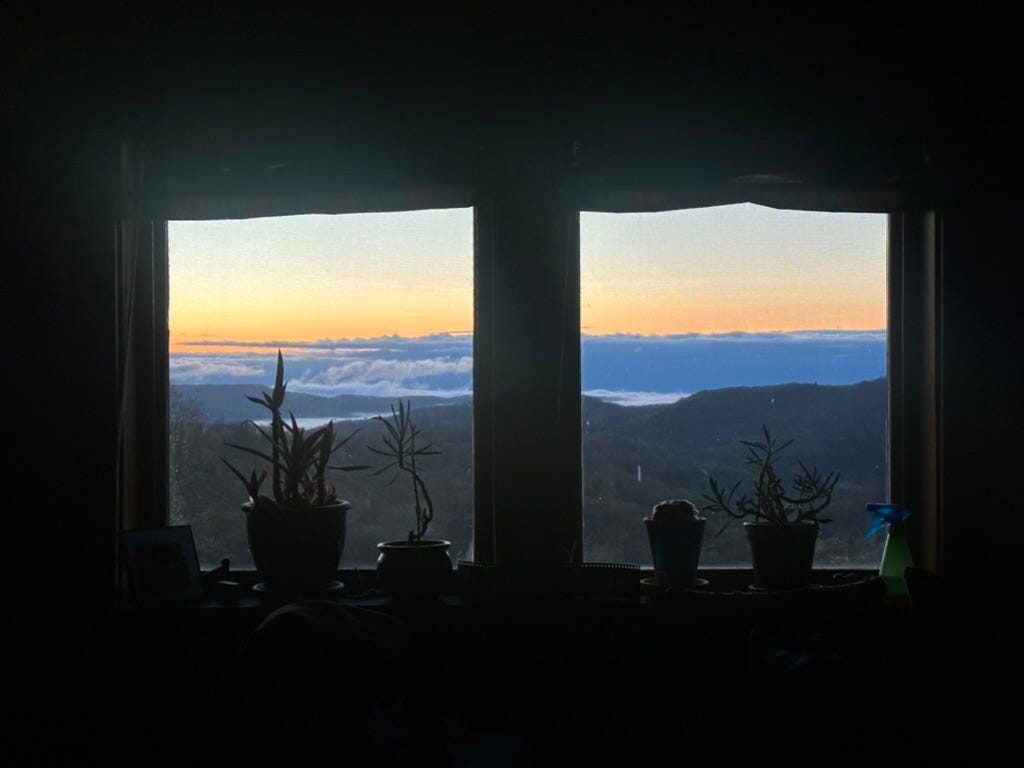
I’m back on Blood Mountain.
I first came here four years ago, in what we’ll call the nadir of my emotional existence. I was literally hiding. There’s no service up here, so I didn’t have to deal with emails from my landlord asking what was going on. It was miserable. It was the most beautiful possible place to be miserable. I felt like a millionaire waiting out a pandemic in the Swiss Alps.
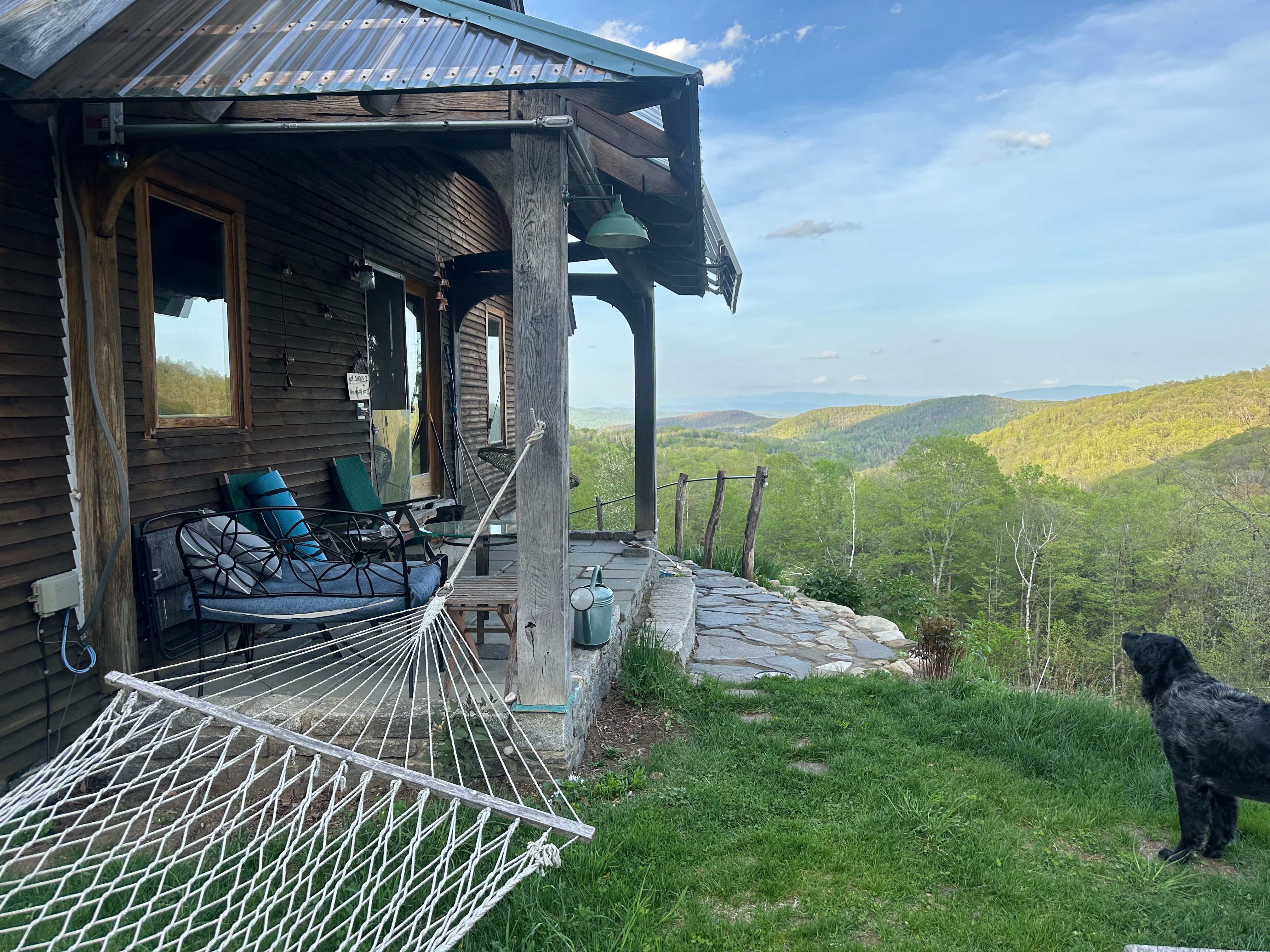
In reality I was shoveling horse shit, and that is what brought me back. A little while ago, Glenn and Kat told me they’d be in Ireland for a couple weeks, and asked if I wouldn’t mind looking after the horses while they would be away. “Of course,” I told them, stuffing several pens and a third draft of a manuscript into my duffel.
On day two I received terrible personal news. The kind of news that brings your whole sense of self to its knees. On day three I got really fantastic professional news, the kind that makes you text your parents. It’s day five now, and all a wash. External influences on my psyche have canceled each other out to moot. I’m left here once again to ask myself the question— the question I am terrible at asking myself anywhere near the confines of a metropolitan— “How’s it going?”
Fifty miles away away I can see the peak of Mt. Washington. I’m staring at its hook nose atop the presidential range right now. I’ve climbed it several times, but never as an adult. Once I went up it in boxers. Another time I walked while reading the Bible. I was maybe a weird kid. I am possibly a weird adult, in the body of a normal adult. These things are so difficult to know.
What do you think about when you look over a vista? What happens in your mind? Do you think about how small you are, or wonder how long is appropriate to look before you can turn away? I stared for a while, wondering what I was supposed to wonder, and kept hearing waves of breezes rustle the leaves above me before feeling them paw at my back and then continue on, leaving a ripple of shaken branches move slowly through the valley below me. I could feel sunlight leak through a gap in the clouds, strike my crown, and fade again into shade. I watched that splotch of sunlight speed down the mountain, cross a quick gulley, and then slowly climb the opposite knob. Ten minutes later, I could see it spilling yellow light onto a hilltop a few miles away.
Glenn has a page-a-day calendar much like the one I have at home. But while mine has daily definitions and etymologies, his has quotes. I hate quotes. I never find them profound, and the ones I do like, I can never summon in the perfect moment. I turned the calendar onto its face so I didn’t have to see the dates— one of them reminded me of an event I was missing; the next was the birthday of an ex— until finally my heart started breathing, and I could look at a calendar without having a mild breakdown.
Staring up at me was this:
“Writing Fiction is like remembering what never happened.” — Siri Hustvedt
Do you see what I mean? The drivel they push on us?
First of all, who is that. Second, is this quote only meant to apply to people who write fiction? That seems like too small a demo to write a quote for. That’d be like saying, “installing a bathtub is like creating a bath for someone in the future.”
The sound of a branch breaking brought me back to the valley. I’m responsible for driving Glenn’s pickup through the woods to look for trees to take down for firewood. The city-dwelling conservationist in me worried about deforestation, until I figured that if one man takes down two hundred mature trees per year, you only need twelve thousand trees to remain net neutral. I started counting the trees on Glenn’s mountain, and soon noticed that the amount of trees exceeded what I could hold on to in my mind. I decided the forest was fine.
But I kept counting. I started forming little patches of trees, and then multiplying the figure I counted within the patch by the amount of patches I could see. I would do it once and get something like 36,000 trees on this side of Blood Mountain. I’d do it again and get 120,000 for the exact same stretch of land.
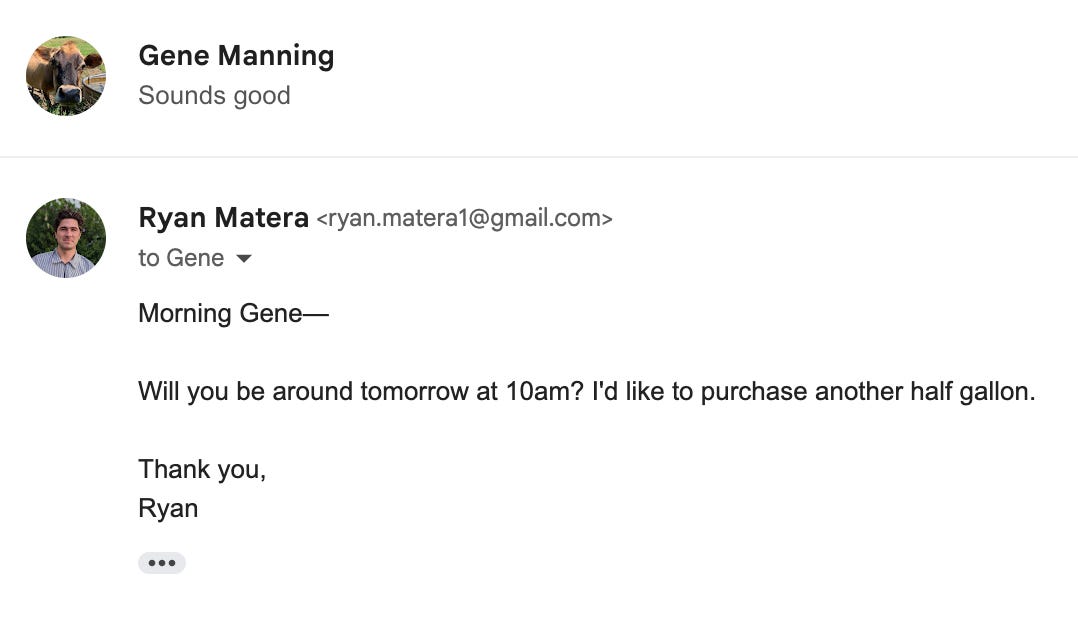
Before I started counting the leaves on each tree, I became aware of a tick in my brain: I was getting distracted. This is bound to happen, but my distractions were all in the same direction. They were all future-oriented. I kept imagining myself in situations I might one day be in, and what I would say in that situation. Some of these felt likely to occur— I’d imagine greeting Gene tomorrow morning, when I go to his farm to buy a half gallon of milk. Some of them were ridiculous— a conversation with an old friend who I haven’t seen or talked to in years. But this division is misleading. Both of these— my very likely conversation with Gene and the ridiculous argument with the lost friend— are illusory. They are future-oriented illusions. AKA, fantasies. I lost my count of the trees, but I think I was getting somewhere.
What is this obsession I have, with pre-imagining interactions? I don’t think this is the norm. I bet there are plenty of others like me, and plenty of others whose “distraction land” is a very different place. Some of you might get lost in memories. Some of you might have your eyes or ears caught by something in the physical world. While avoiding the boring labels (ADHD, Autism, all that jazz), I’m guessing that what we call “healthy” is probably a pleasant mix of several of these options. “Healthy” probably also includes not getting distracted much at all in the first place, except for the amount which keeps abstract thought alive.
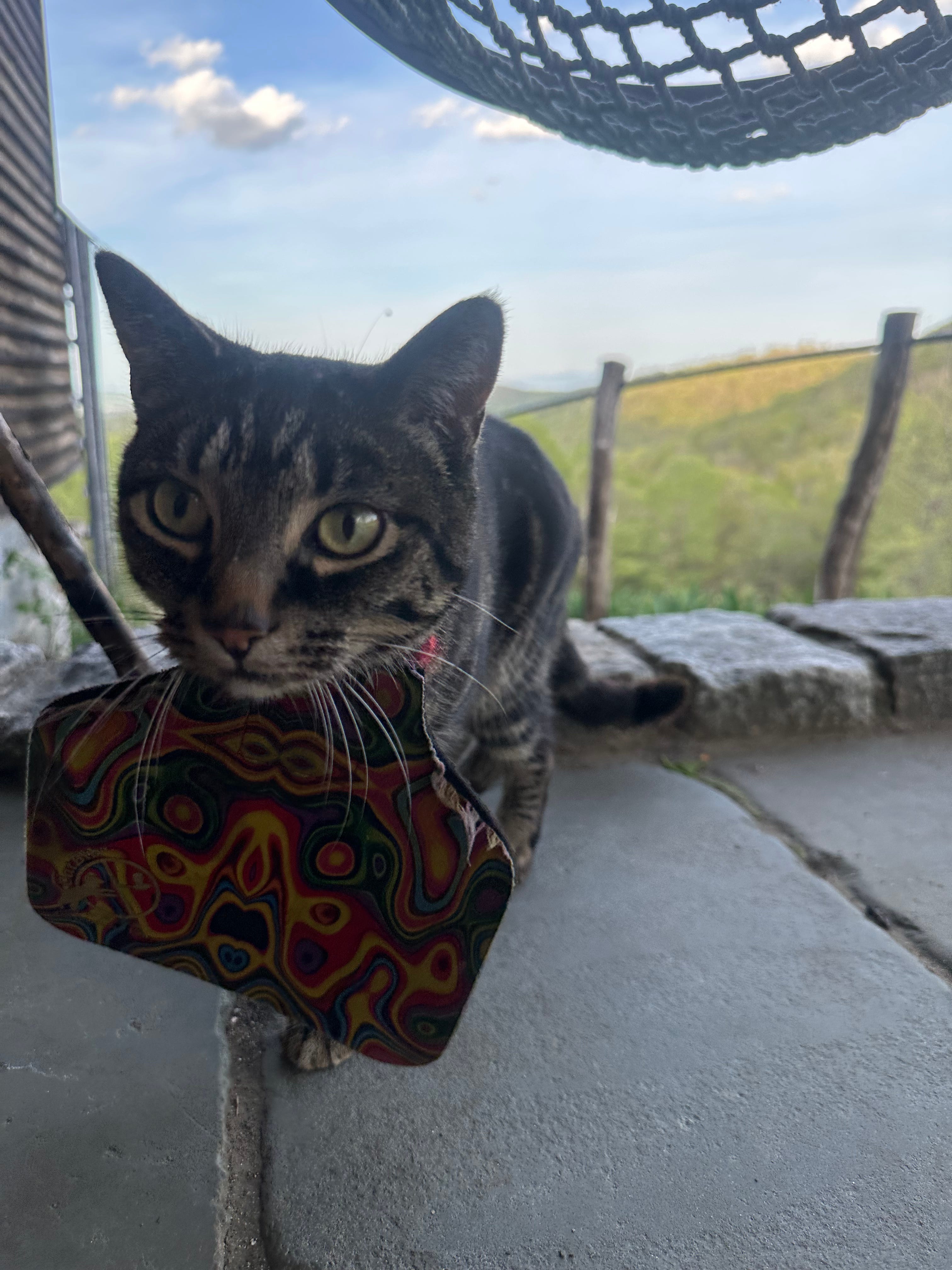
I can tell something has just changed, barometrically. Two of the three animals sitting beside me just came to my lap at once. This includes Cosmo, the cat, who in very few circumstances will find a reason to approach me. I’m noting this in case you believe in barometry and its effect on thought as much as I do, in which case you’ll want to know, for these last few paragraphs, that a small front is now carrying a southeasterly wind, and there will likely be a brief sunshower in the next twenty minutes.
I know this because I’ve been sitting out here, staring at this forsaken valley, for five days. Something I learned from road tripping is that midwest and northeastern climates come in three-to-five day personalities. Each of these brief systems have patterns and tendencies which you can start to read if you pay attention. I’ve been reading this system all weekend, and I’m pretty attuned to it. This is the sort of shit the human brain is adapted for. This is productive thought. So what’s all this other bullshit? Why do I keep planning small talk with Gene, down to the most inane detail? Why am I imagining myself telling a friend which door I’m gonna leave my boots outside tonight, so that they’ll be there in the morning? And what does it mean that my “distraction land” is so petty, so desperate?
At this point you might get concerned that the ending here is gonna be like, “we should remain more present.” Because that’s beneath the mouse-car, isn’t it? I’d rather say something confusing and unsatisfying than be so trite1. This shit is about me, and, according to footnote 1, about you. Because I can’t chalk it up to living in a complicated social network (we all do), especially since I haven’t talked face to face with a human in almost a week. And yet it remains the focal point my brain tugs me to— plotting interactions so to maximize their safety, their profoundness, the way they’ll preserve an image of myself in the minds of others (Quixote) and the way they’ll allow me to externalize my inner experience (Narcissus). Anything besides being, ahem, present.
Cosmo was right. A brief shower tickles the titanium roof of my porch, and is gone as quickly as it arrived. I will be able to watch it unfurl onto the Green Mountains for another few paragraphs.
For the last decade, I would take thoughts like this and run to the page. I would turn them into fiction in a way that produced some decent, wondrous, beautiful moments. Mouse-car moments. See but the problem was— is— that the second I convert my fantasy into prose it dies. And now I’m left editing scenes of a novel that were written two years ago, and which have ideas about the world that I can’t quite claim as beliefs. I did not hold these ideas for very long before pressing them into ink. My mind didn’t have time to mull them, for them to ferment. Like this very idea, of this very essay, proves: I have become compensatorily deft at syncing my revelations with language. I am able to have thoughts about as quickly as I can pen them.
But shit. I haven’t spent any time with those thoughts. It’s very possible that I’ll have written this quicker than it takes for you to read it (minus the leaf-counting diversion). This is not an idea I’ve been sitting with for weeks, years, before composing. Writing Fiction for me has not been, Siri, “like remembering what never happened.” It has been planning an elaborate party, an elaborate moment, for people that don’t exist.
In twelve minutes I have to go shovel shit. I will post this essay before that happens, and like all good labor, that shit will save me. This shit has been saving me. Bill Callahan talks on his new record about how he started making music as a way to communicate. “As time wore on,” he says, “I found myself increasingly turning to my guitar instead of other people in times of loneliness and sorrow and confusion. Which is the exact opposite reason of why I got into this in the first place. I started to wonder: is this creativity, or pathology?”
In the refrain he tells himself “it’s important to not treat your lifeboat like a yacht.” I’m down to nine minutes. I’m nothing if not punctual with my obligations. After I shovel the shit into a wheelbarrow, I’ll cart it outside the barn and dump it a few yards away. My mind, as you can guess, is already in the barn. And already I can feel what brought me to the page slipping away. Like that splotch of sunlight coasting down the valley, I will soon lose sight of it. Soon after that, I will forget exactly what it felt like. The way it hit my right temple, and forced my right eye to squint. I’ve staked so much of my self worth on being able to get it down before it's gone. I have committed myself to a life of desperately grabbing onto ideas before they’re carried off by the wind. I’m mostly pumped. A small part of me, though, knows what I need to do. I need to remain more present.
Although, if you really think about it, it’s only become trite because of how profound it is. 99% of what’s wrong with you can be solved by breathing. I keep feeling out here like I am the valley. Does that make sense? I’d be having my little moment, staring out over miles of forest, and all of a sudden the illusion of a separation between me and it would dissolve. Of course I’m the valley, we all are. The same wind passes through all of Us. We’re literally just pieces of nature with the illusion of selfhood. It sucks how boring all the obvious Truths are. We have to keep getting at them from weird angles in order to make them feel like anything worth listening to. This whole essay is derivative of that one idea.